







The Most Common Question About 3D Printed Footwear
Whenever people see a pair of 3D-printed shoes for the first time, they almost always ask the exact same question:
"Since it’s all 3D printing, can I just print a pair of shoes on my 3D printer at home?"
It is a fantastic question. However, the short answer is no.
The term "3D printing" is not a single, magical technology. Instead, it represents an entire family of manufacturing processes. Think of it like the word "automobile." A sedan, an off-road SUV, a heavy-duty truck, and a sports car are all automobiles, but they are built for entirely different scenarios.
3D printing works the exact same way.
The 3D Printing Family: Which One Fits Footwear?
To understand why your desktop printer might struggle to make a pair of running shoes, we need to look at the three main types of 3D printing technologies used today.
1. Extrusion (FDM - Fused Deposition Modeling)
This is the type of 3D printing the general public is most familiar with. The material is heated and squeezed out layer by layer—much like toothpaste—slowly stacking up to form a product.
Many popular desktop 3D printers, such as Bambu Lab, rely on this process. FDM is incredible for DIY projects, educational models, jigs, and product validation. It can even print flexible materials like TPU. However, if you want a shoe that requires long-term wear and consistent rebound/cushioning, relying solely on consumer-grade FDM technology and standard materials simply cannot meet the rigorous demands of an industrial footwear product.
2. Light-Curing (Resin / SLA / DLP)
Instead of squeezing out material, light-curing technology uses precisely controlled UV light to turn liquid resin into a solid.
If you have ever seen a viral video of a highly detailed shoe slowly rising out of a vat of liquid, you are looking at light-curing technology. Different light-curing routes offer unique advantages in speed, precision, material versatility, and continuous production capabilities. This is currently one of the most important and exciting directions for footwear innovation.
3. Sintering (SLS - Selective Laser Sintering)
This method involves spreading a fine layer of powder and using a high-powered laser to fuse (sinter) specific areas into a solid. Once a layer is complete, more powder is spread, and the process repeats.
The greatest advantage of SLS is its ability to manufacture incredibly complex internal geometries without needing support structures, making it a staple in advanced industrial manufacturing.
Why Are Shoes So "Picky"?
Why is it so hard to print a good shoe? Because a shoe is subjected to far more abuse than almost any other consumer product.
Every single day, a shoe must endure thousands of bending cycles, provide continuous rebound, resist long-term friction, and support varying body weights across unpredictable terrains and environments.
Therefore, creating a truly wearable, long-lasting 3D-printed shoe requires the perfect harmony of four critical systems:
- Materials: Dictate the rebound, wear resistance, fatigue tolerance, and overall lifespan.
- Processes: Determine the production speed, precision, and viability for mass manufacturing.
- Equipment: Ensures the printing accuracy, machine stability, and product consistency.
- Parameters: Control the exposure strategies, layer thickness, print speed, and final physical performance.
The truly difficult part of 3D footwear manufacturing isn't simply printing the shoe—it is getting these four systems perfectly balanced.
The Pollyfab Solution: Redefining 3D Footwear
Because the balance of these four elements is so challenging, choosing the right manufacturing partner is critical.
Pollyfab specializes exclusively in advanced 3D shoe materials and processes. We understand that standard desktop solutions aren't enough for the footwear of the future.
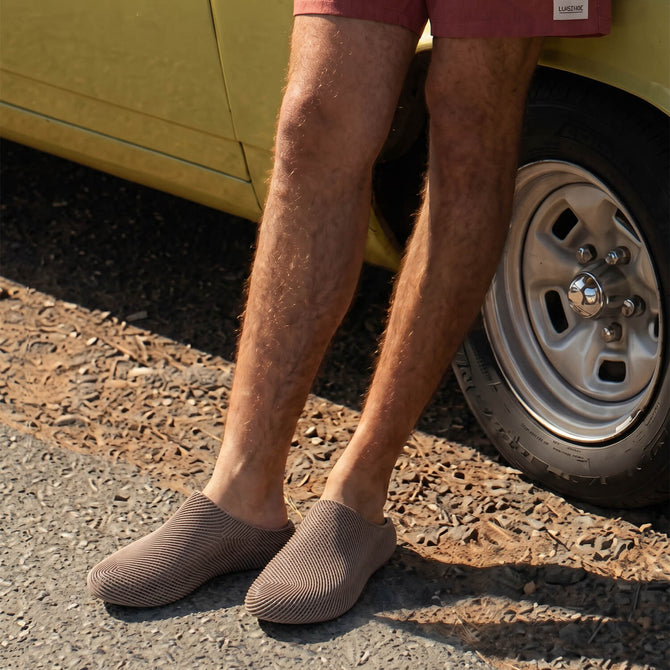
Unlike standard TPU shoes produced by traditional FDM equipment, Pollyfab’s 3D printed footwear takes performance to the next level. By heavily upgrading our materials and printing processes, Pollyfab shoes not only elevate everyday comfort, but they are also significantly more durable and wear-resistant. Furthermore, our technology ensures a much more stable lattice structure, providing consistent, long-lasting support that won't degrade after heavy use.
Final Thoughts: The Future of Manufacturing
In the past, we viewed 3D printing as a single technological novelty. Today, it has evolved into a massive, nuanced manufacturing family.
There is no single process that solves every problem, and no single machine that fits every product. Truly exceptional manufacturing isn't just about choosing the most "advanced" technology; it is about choosing the right technology for the product.
The future of footwear manufacturing is not just about successfully printing a shoe. It is about finding the perfect equilibrium between materials, processes, equipment, and parameters to create something extraordinary.


